New power stage: 24V issue fixed
A new DC-DC converter design fixes the 24V issue of the previous revision, where a specific IC could fail at 24V. The supported range is unchanged: 5–24V, or 24–48V when paired with a Power-5HV.
The brains of the Dig-Octa system.
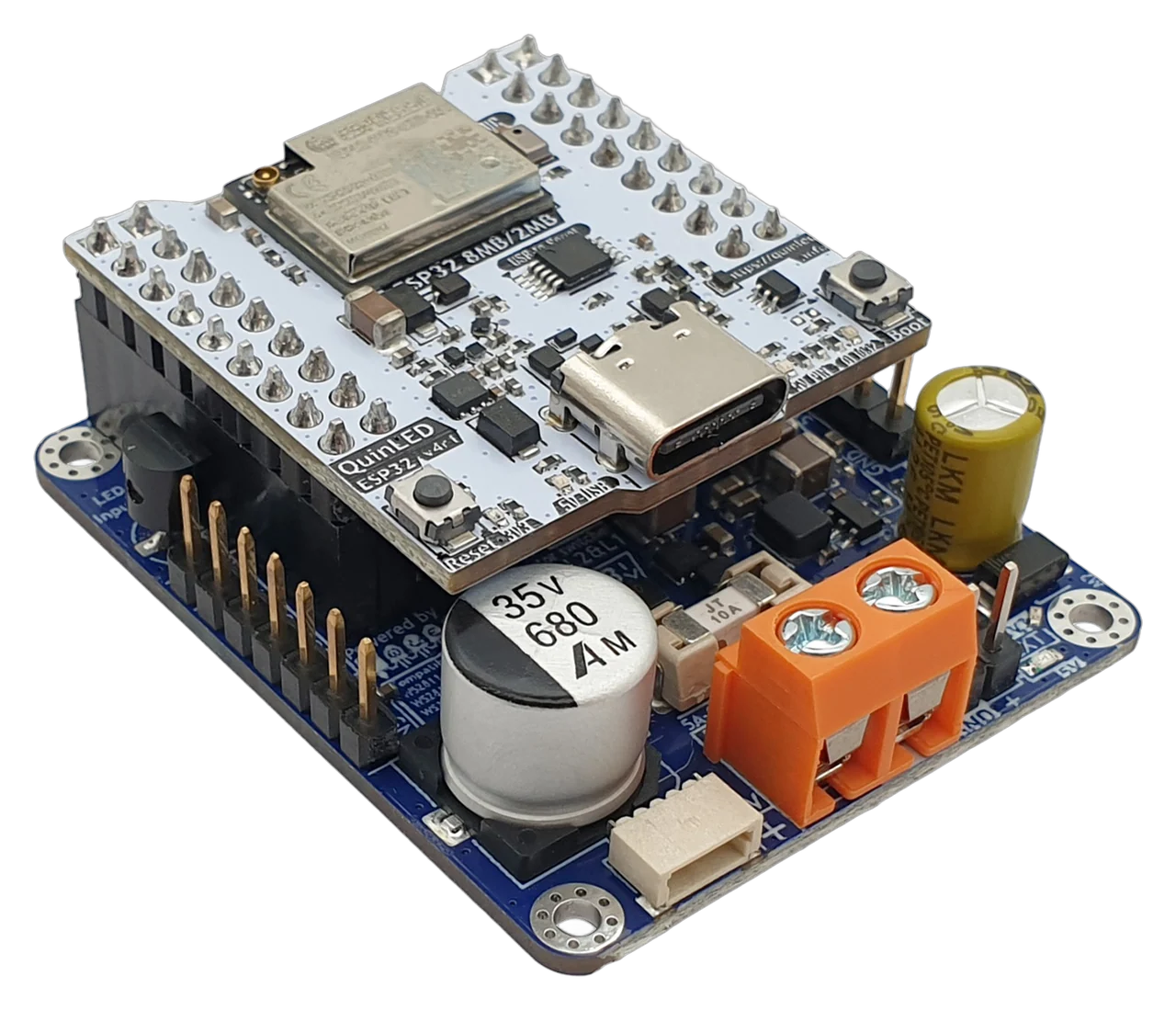
An 8-channel ESP32 controller with Ethernet, micro-SD, an onboard microphone and ESD/over-voltage-protected outputs. It stacks onto any Dig-Octa Powerboard.
Part of the Dig-Octa SystemPricing indexed mid-2026. Check the specific store for current pricing. quinled.shop links you to the reseller, and you check out and pay there.
Revision v4r1, released on 31 October 2026, is a completely reworked Brainboard on a 6-layer PCB. It is still the brains of the Dig-Octa system (eight outputs, Ethernet and micro-SD), and it stacks onto any Powerboard, including the ones you already have. What changed is a new power stage, tougher outputs and room to grow.
A new DC-DC converter design fixes the 24V issue of the previous revision, where a specific IC could fail at 24V. The supported range is unchanged: 5–24V, or 24–48V when paired with a Power-5HV.
Reworked level-shifters add ESD and over-voltage protection on every output. The resistor switcher is gone: the adapted circuit performs well with both short and long data runs, similar to the previous “33R” setting.
A new header accepts future top boards that add functionality. Think doubled outputs, integrated Diff-Solo or Diff-Adv ports, DMX in/out and more. Top boards are fully stacking, including power.
A QEXP expansion port comes with a cable to female Dupont connectors in the box, so wiring up accessories needs no soldering.
The relay port and circuit are rebuilt around a load switch. It still provides a 5V trigger output for an external relay on its own dedicated pin, now on a smaller connector with a pigtail cable included.
A digital PDM microphone is now built in for sound-reactive effects, with a jumper to disable it electrically when you don’t need it.
The I²C port is now a Stemma QT / JST-SH 1.0mm connector, so sensors and small displays simply plug in.
The Ethernet socket’s lip now points up. The Ethernet power jumper is gone; the SD-card jumper remains, to cut power to the card reader and its pull-ups.
The Brainboard v4 is the controller half of the Dig-Octa system. Stack it on the Powerboard that matches your current and connector needs and it runs eight outputs from one place: a whole-house holiday display, façade lighting, or a workshop full of strips on a single wired-Ethernet controller. With the 24V issue solved it is a confident choice for 24V installs again (or 48V with the Power-5HV), the built-in microphone makes even a big install sound-reactive, and the new top-board header means the same Brainboard can pick up new tricks later. Ready to build the full setup? Check out the Dig-Octa System to pick your Powerboard.
| Outputs | 8 × data (ESD + over-voltage protected) |
|---|---|
| Relay | Dedicated 5V trigger (load switch) |
| Input | 5V – 24V (24V – 48V with Power-5HV) |
| MCU | ESP32 · 16MB flash (no PSRAM) |
| Networking | Ethernet + WiFi 2.4GHz |
| Storage | micro-SD card slot (power jumper) |
| Microphone | Onboard digital PDM mic (disable jumper) |
| Expansion | QEXP · I²C (Stemma QT / JST-SH 1.0mm) · top-board header |
| PCB | 6-layer |
| Pairs with | Any Dig-Octa Powerboard (incl. existing ones) |
| Revision | v4r1 |