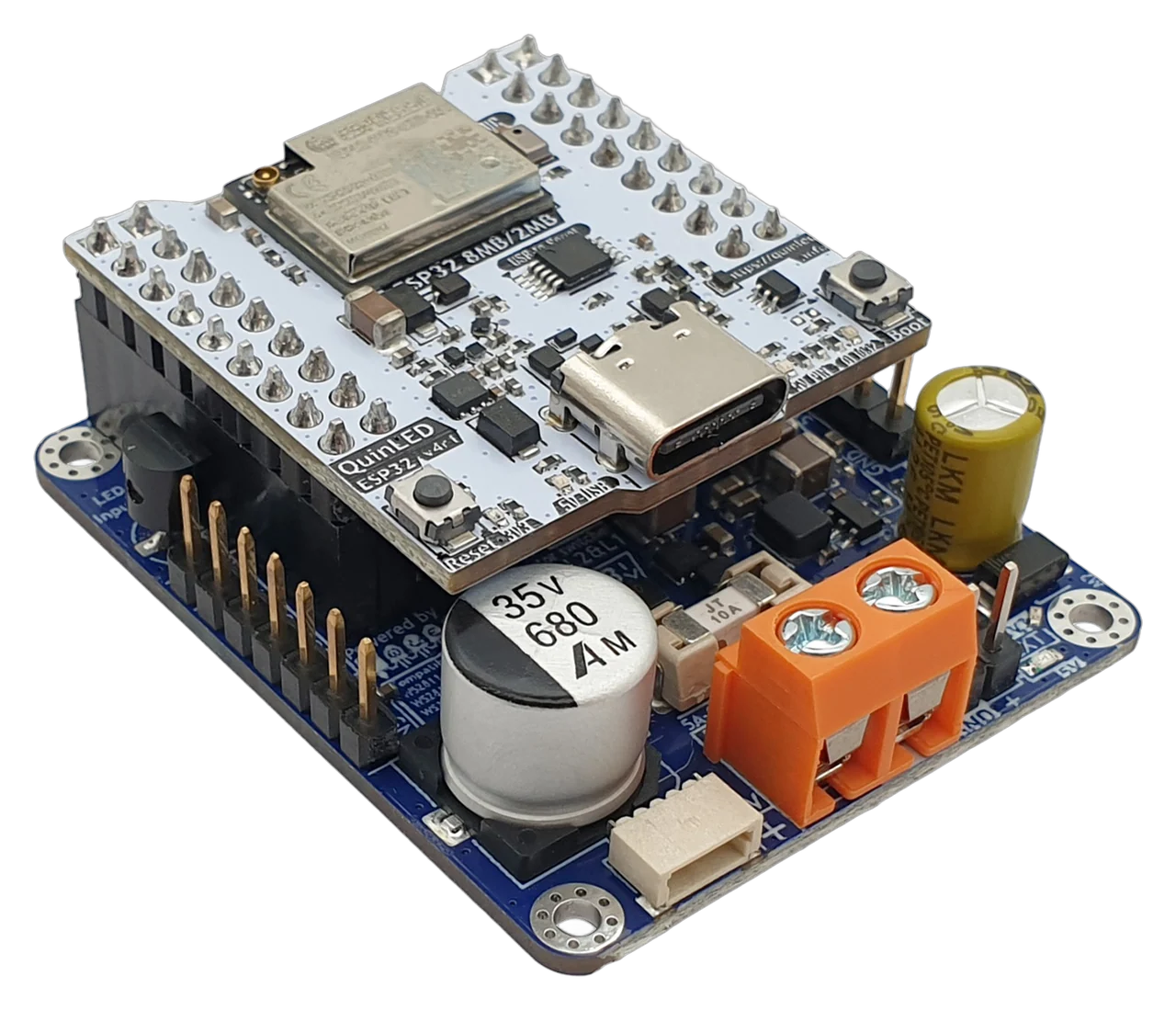
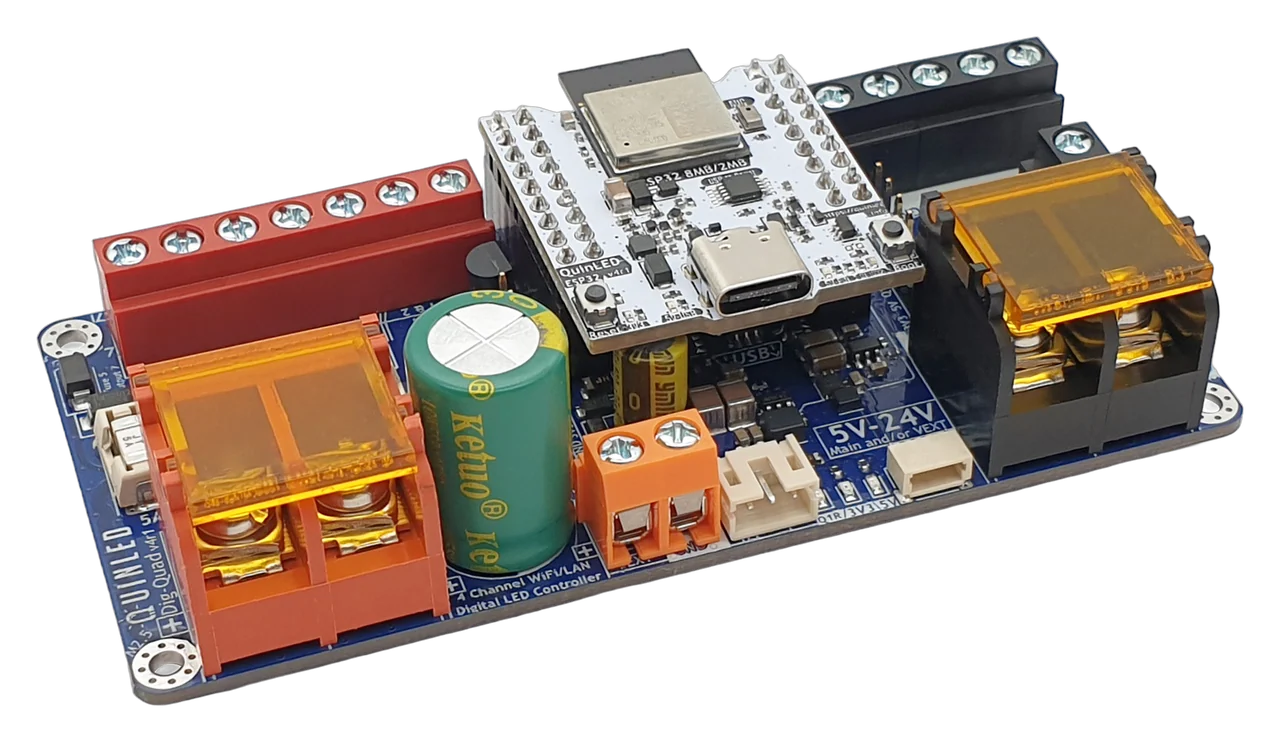
New module: 8MB flash, 2MB PSRAM
The board now uses the ESP32-PICO-MINI-02-N8R2, which comes with 8MB flash and 2MB PSRAM, so firmware is no longer squeezed into 4MB. WiFi is more stable and power use is lower than on the previous versions.
The brain behind the boards, now with 8MB flash and a microphone.
QuinLED's own ESP32 board, rebuilt around the ESP32-PICO-MINI-02 with 8MB flash, 2MB PSRAM and an onboard microphone. Choose board antenna, external antenna or Ethernet.
Pricing indexed mid-2026. Check the specific store for current pricing. quinled.shop links you to the reseller, and you check out and pay there.
Revision v4r1 was released on 31 October 2026. It keeps the small board and the three versions (AB, AE and ABE), and moves to a new Espressif module with a pinout of its own.
The board now uses the ESP32-PICO-MINI-02-N8R2, which comes with 8MB flash and 2MB PSRAM, so firmware is no longer squeezed into 4MB. WiFi is more stable and power use is lower than on the previous versions.
The pins sit in four rows of nine and most GPIOs have moved. The layout is still mostly compatible with the previous board and generic modules, and the pin map is printed on the back.
Onboard LDOs run the board from USB-C or the 5V pin, and the Dig-Uno v4 and Dig-Quad v4 can feed it 3.3V directly. Load switches pick the input, limit over-current and block reverse current, so USB-C and the 5V pin can be connected at the same time. On top of the USB ESD protection, the board adds extra ESD protection diodes.
Every v4 carries an I²S PDM microphone, so sound-reactive effects work without adding anything. On the v2 that took the separate ESP32-AE+ module.
The ABE (Ethernet) version is now one PCB instead of two stacked boards.
The LEDs no longer light up the room. Green shows 5V (one for USB-C, one for the pin), orange shows 3.3V and the blue one sits on a GPIO.
The QuinLED-ESP32 v4 is QuinLED's own ESP32 board, built on Espressif's ESP32-PICO-MINI-02-N8R2 module (dual-core 240MHz, 8MB flash, 2MB PSRAM, 2.4GHz WiFi). It has USB-C with a CH340X USB-to-serial chip and auto programming, reset and boot buttons, an onboard I²S PDM microphone and a load-switched power input with over-current and reverse-current protection. It comes in board-antenna (AB), external-antenna (AE) and Ethernet (ABE) versions and is the module on the Dig-Uno v4 and Dig-Quad v4.
The fourth generation of QuinLED's own ESP32 board, designed and produced in house. It moves to Espressif's ESP32-PICO-MINI-02 module with 8MB flash and 2MB PSRAM, so firmware has room to grow, and it carries a microphone for sound-reactive effects. It is the module on the Dig-Uno v4 and Dig-Quad v4, where it can run straight off the board's 3.3V. It also works on its own as a general ESP32 board, powered from USB-C or a 5V pin. Pick board antenna (AB), external antenna (AE) when the signal is weak, or wired Ethernet (ABE).
| MCU | ESP32 (PICO-MINI-02-N8R2) · dual-core 240MHz |
|---|---|
| Memory | 8MB flash · 2MB PSRAM |
| Wireless | WiFi 2.4GHz + BT · Ethernet option |
| USB | USB-C · CH340X serial · auto programming |
| Power in | USB-C or 5V pin · 3.3V direct feed |
| Protection | Load switches (over-current, reverse current) · ESD |
| Microphone | Onboard I²S PDM mic |
| Pinout | 4 × 9 pins, own GPIO layout |
| Buttons | Reset · Boot (usable on GPIO0) |
| Variants | AB · AE (antenna + pigtail incl.) · ABE (Ethernet) |
| Revision | v4r1 |